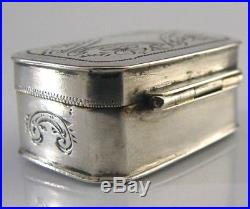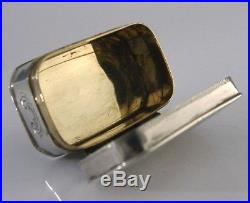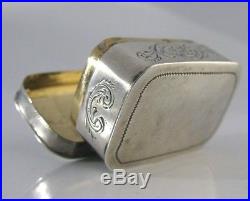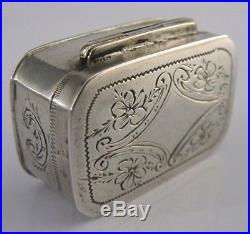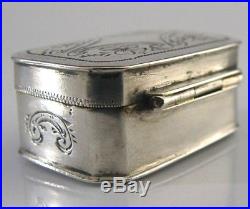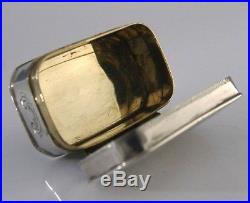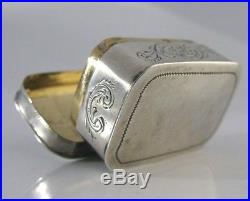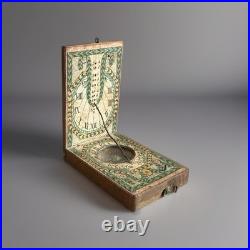
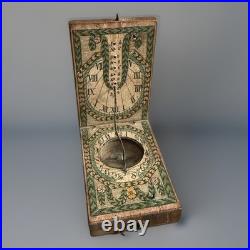
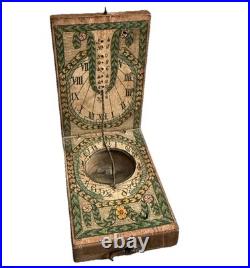
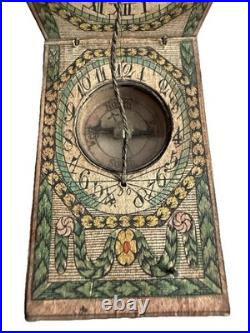
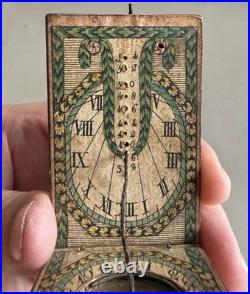
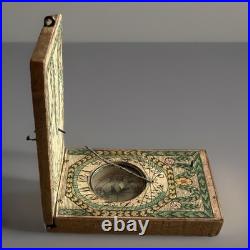
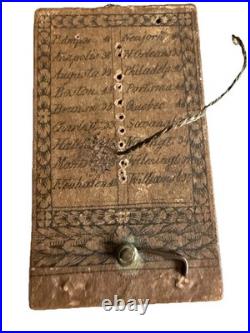
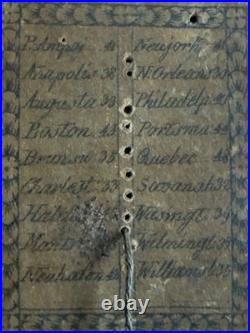
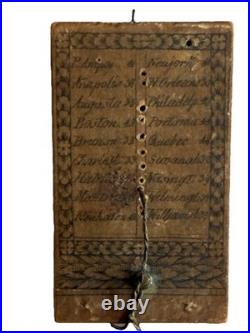
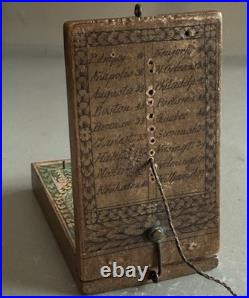
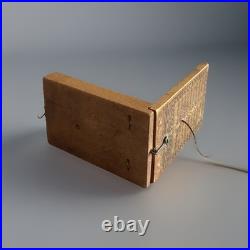
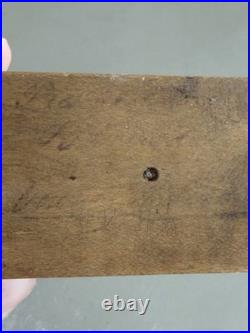
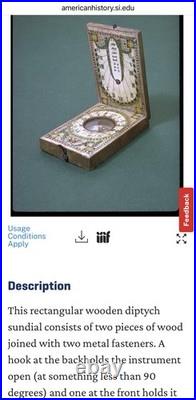
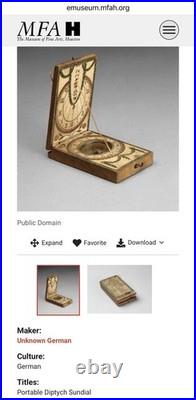

Rare German wooden diptych sundial with an integrated compass, likely crafted by David Beringer in the late 18th to early 19th century. Many of his pieces were made for travelers who would need to use the sundial at different latitudes. This particular piece is unique in that all of the latitudes and cities listed are in North America. Most examples in museums and available for sale were made for use in Europe. This rectangular wooden diptych sundial consists of two pieces of boxwood joined with two metal pin hinges and two hook fasteners. A hook at the back holds the instrument open (at something less than 90 degrees) and one at the front holds it closed. Printed, hand-colored paper dials are pasted onto the inner surfaces with black ink colored with red, green, and yellow. On the front is a latitude table for 15 American cities from Annapolis to Williamsburg, and 3 Canadian cities, Halifax, Montreal and Quebec. On the inside reverse are holes for latitudes of 39, 36, 42, 44, 46, 48, 50, 52, snd 54 degrees. It also features a horizontal compass in the base. Beringer was one of the first compass makers to create out of wood and printed paper instead of ivory or other precious metals. This made his wares more affordable. His workshop flourished between about 1777 and his death in 1821, and his name became synonymous with portable, wooden diptych and cube sundials. The box measures approximately 2.5 inches by 1.5 inch and. The front top panel listing cities is slightly worn, affecting two of the listed cord as visible from photos. The bottom reverse panel has remnants of a name in ink, likely a former owner. Because they are old, they were used and will not look new or new-like. They likely show wear, fading, scratches, chips, cracks, past repair/restoration, original imperfections and/or damage from normal use. Significant issues are shown in photos. Examine photos carefully as they are part of the description. Imperfections were factored into pricing.