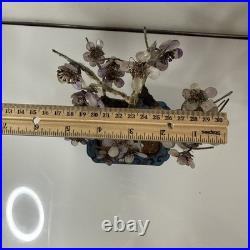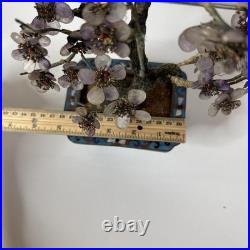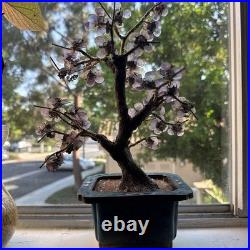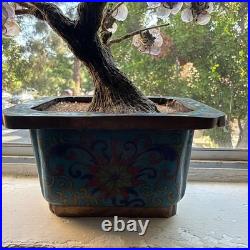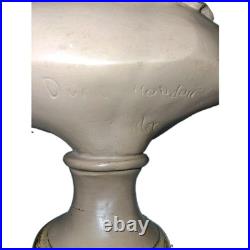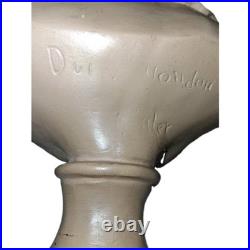

The product is a rare antique vase from the Wang Bing Rong type, featuring raised relief design in yellow porcelain with lotus flower and crane theme. Originating from China in the late 19th or early 20th century, this miniature vase at 2 1/5 tall is a unique piece that showcases traditional craftsmanship and artistic detail. With its historical significance and distinctive style, this vase would be a valuable addition to any collection of Asian antiques or antique vases. All of my items listings are vintage or antique pieces sourced from antique stores and estate sales or from my own private collection, unless otherwise stated. My pieces are not new and most do not have original packaging or tags. I only list items with minor wear and many look as though they have never been used. All items are vintage and not new, unless otherwise stated. There was a misrepresentation in the description or condition of the item. Thank you for considering my items.
This offering is for a rare carved ox horn cup. The cup dates from the late 18th to early 19th century and is carved from one piece of horn with a tin trim on the bottom edge and a small hanging loop. The cup features a beautifully carved name of “ALVARO RIPLADA” surrounded by carved foliates and scrolls. The length is app. 5 not counting the hanging loop and it measures app. 3.5 wide, the depth is app. The condition is as seen in our photo’s. There three small cracks in the more pointed end and a longer crack in the rounded end which measures app. Otherwise the cup displays great with a wonderful patina and an untouched surface. International Buyers – Please Note. If additional photo’s are needed or you have need of answers to questions we do not address we will be happy to supply them. WE USUALLY SEND OUR INVOICE WITHIN 1 HOUR OF THE AUCTIONS ENDING.
Original condition, both lamps and bulbs off and on switch work. Dusty but overall recondition for being over 100 years old they originally had crystals or prisms hanging off the pedals I believe, but did not see at the Estate very beautiful and elegant lamps. These I believe were made in the late 1800s to very early 1900s bulbs work excellent as well to the knob often on switch switches. I did Hook them up to a wire to test. Cord is not included.
An early 19th century Georgian Spode porcelain teapot and matching oval stand featuring a classic blue and white transfer-printed Willow pattern. The teapot has a cylindrical body with a straight spout and a curved, angular handle, both accented with delicate gold gilt detailing that also circles the rims and the base. The intricate landscape scene depicts traditional pagodas, a weeping willow tree, a bridge, and distant mountains, all set against a white porcelain ground. Stand dimensions: 18.25 x 15 cm – Teapot length: 26 cm – Height: 14.5 cm – Width: 11.5 cm. In great overall condition with a tiny chip to end of spout. A rare teapot in itself but even more so with the matching stand. Please inspect images thoroughly and enlarge, if you have any questions or require more photographs please do not hesitate to ask.
An exceptionally good and highly decorative mahogany (and other) early 19th century William IV period pedestal table, with the most attractive geometric parquetry top. All original except for a couple of replacements to the ebony wood outer boarder/tray edge. Cracks to the base are purely cosmetic, not structural. Stands well, no wobble. H 72 cm x W 41 cm.
Authentic antique Tibetan Buddhist Thangka, depicting one of the Sixteen Great Arhats (enlightened disciples of the Buddha). The hand-painted piece, executed with pigment on cotton, showcases classic Sino-Tibetan artistic influences, blending spiritual iconography with a stylized natural landscape, and delicate details. The Arhat is portrayed as a wizened sage, seated by a cave in a secluded mountain landscape wearing traditional red monastic robes, and holding a fly whisk with a long handle in his left hand. The sacred fly whisk represents purification and the sweeping away of ignorance or mental afflictions. In Tibetan Buddhist iconographic tradition, only three Arhats has this significant attribute: Angaja, Vanavasin, and Vajriputra. Positioned at the bottom right, the deer is a traditional Buddhist symbol of longevity and the Buddha’s first teaching at Deer Park. Shown at the bottom left, two geese/cranes symbolize longevity and peacefulness. A small, red Amitabha Buddha figure rests in the clouds in the upper-left corner, signifying spiritual lineage, a common innovation in Tibetan Arhat thangkas. Item: Antique Tibetan Buddhist Thangka. Angaja, Vanavasin, or Vajriputra. Set Number: The only known survivor out a set of 16 paintings. Date: Early 19th Century. Material: Pigment on Cotton. : 7.5×12.75 inches (19×15 cm). This is a delicate antique textile displaying authentic patina and wear. Significant age-related wear, including paint loss, fraying, fading, and tearing along the borders. The overall composition-including the small secondary Buddha figure-is a standard element in larger sets of sixteen Arhat thangkas. This is the only known survivor of one such set. In early Buddhism, the Sixteen Arhats were those who had followed the path taught by the Buddha, and achieved release from the cycle of birth and death, or samsara. In later Mahayana traditions, the Arhats were understood as a set group of disciples to the historical Buddha Shakyamuni, and an artistic tradition arose that depicted them as wizened sages with exaggerated features.

This rare antique early 19th century Sakuyuki Japanese terracotta water dropper is a unique piece from Japan. Made in the first quarter of the 19th century, this terracotta water dropper is an antique original that showcases the traditional Japanese sculpture and calligraphy artistry. It features a stunning sculpted foo dog along with large characters on each panel that are done in high relief. It is in great condition, has acquired a lovely patina from age, and measures 2 3/4 inche stall by 2 inches wide.


Rare Late 18th Early 19th Century Dutch Brass Whale Oil Lamp. Nice example of the rarer Repousse type. Does have the lower spout missing but even a novice metalworker could replace the missing one with simple sheet brass and a little soldering, which is all it would have been in the first place. Interesting and underated these things as they are quite ingenious being able to free stand and be hung up and the flattened off back to the base ensures the lighted wick is kept away from the wall as far as possible. Dia of abase approx 11.5cm. Very good See photos.
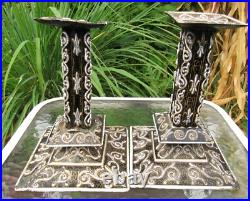
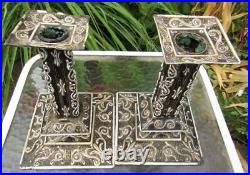
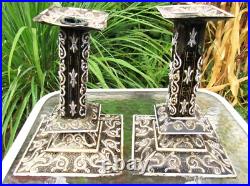
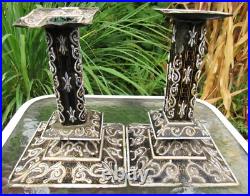
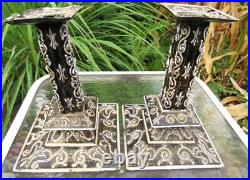
This is a rare and stunning pair of early 19th Century French candleholders. They are enamel on copper. They have wear from age and use – see photos. Overall though they are spectacular looking pieces. The measure 8 1/2″ tall x 6″ wide at their base. We’ve added many photos from every angle we could think of so please see photos for condition and design. Loading...X